Materiality of the Sacred
April 2- August 31, 2026
Upper Gallery
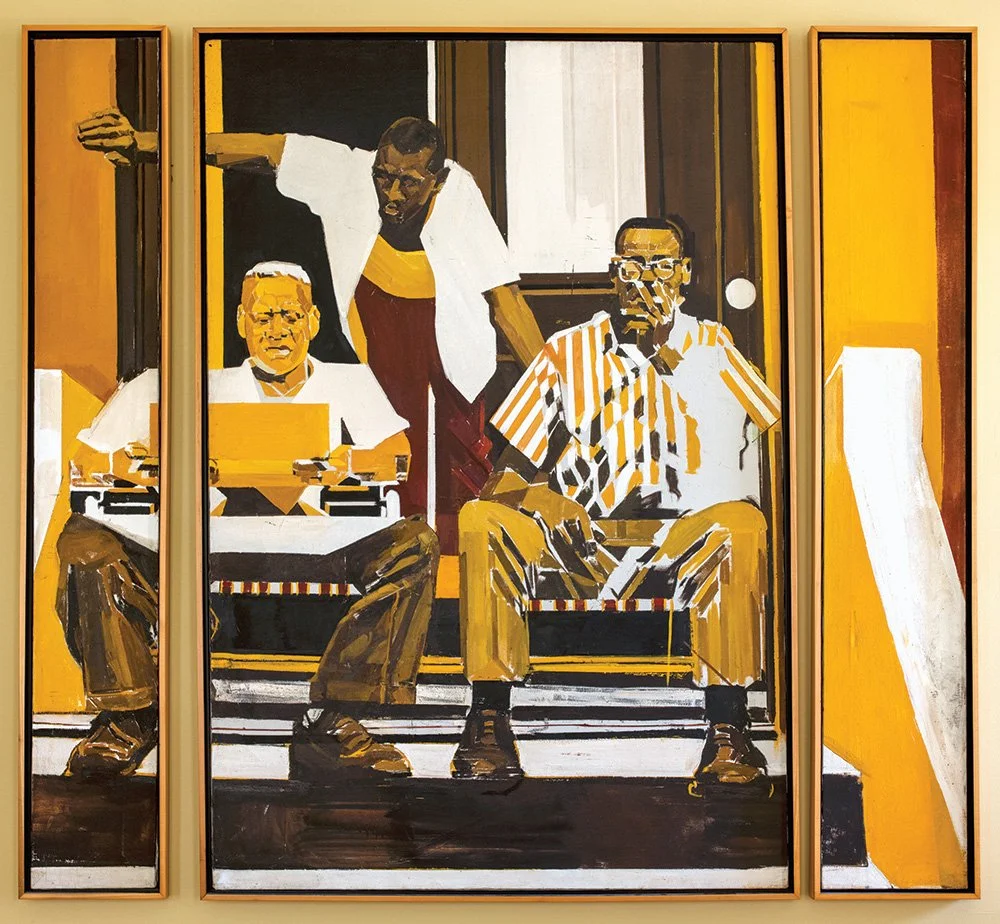
Lorenzo Swinton (Clarksville), Valkyrie X. Acrylic, foil, sand on raw canvas, wooden arch frame.Swinton explores the intersection of faith, intuition, and transformation, positioning creation itself as both a devotional act and a form of revelation.
What is Holy and Sacred, what is Divine?
Materiality of the Sacred introduces artists’ interpretations and expressions of the sacred. The artists presented in this exhibition explore the nature and presence of God as both a force and presence. Prayer is used as a way to reflect, question, and stay in constant dialogue.
This exhibition investigates complex manifestations of memory and how it shapes religious experience, culture, family practices and community identity. Through carved form, painted surface, woven thread and welded steel, the works resonate with the artists’ beliefs in and relationship to the divine. Through material, imagination, revelation, and creative technique, ideas of what is sacred are fully embodied.
Three curatorial themes emerge to reflect the influence of culture on the individual and the collective. Embodiment of the Divine reveals welded iconography, spaces for contemplation and provides moments of reflection. Faith and Memory honors ancestral voices and presents profound representations of what is stitched together by time and experience. In Practice as Revelation, artists work outside of conventional and inherited belief systems, reveal the hidden, respond to visions and invite nuanced conversation.
This exhibition acknowledges foundational pillars like William Edmondson and includes influential figures in black craft practice such as Bessie Harvey, Gregory Ridley, Joe Light and Earl Hooks. It features their creative descendants Ted Jones, Wilson Lee Jr., Charlie Newton, Aundra McCoy, and stellar innovators Samuel Dunson, Elisheba Mrozik, Rahn Marion, Francis Akosah, Lorenzo Swinton, James McKissic, Karen Sullivan and Desmond Lewis.
Lewis explores and deconstructs symbols and elements of sacred spaces, and examines their impact. Samuel Dunson guides us to peer through the lens of ancestral space and recognize the strength they carry and emit to us, not only as bearers of family history, but carriers of future promise. Aundra McCoy and Elisheba Mrozik pay homage to their matriarchs’ stories through fabric and tangible elements. Francis Akosah celebrates West African cultural traditions and creates space for contemplation, reflection and meaningful connection.
Materiality of the Sacred honors precolonial, alternative, and postcolonial spiritual practices, presenting them on equal footing with dominant faith traditions. These practices are vital to understanding the Black experience—from the violence of the Middle Passage to the ongoing struggles of contemporary civil rights movements. In honoring the sacred, we honor the stories that long to be heard. We honor the histories that have been central to survival, resilience, and inspiration for community and self-determination.
Materiality of the Sacred is co-curated by Crafting Blackness co-director Karlota Contreras-Koterbay and Fisk University Art Department Coordinator, Lakesha Calvin.
This exhibition is presented by Fisk University's Carl Van Vechten Gallery in partnership with the Crafting Blackness Initiative with Tennessee Craft and support from the Tennessee Arts Commission, ETSU Slocumb Galleries and partners.
Please visit the https://craftingblackness.org for more information.
Exhibition Partners:
Main Lobby
Helina Metaferia
b. Washington, DC
Lives and works in New York, New York
Headdress 62, 2023
Mixed-media collage
Courtesy of the artist
Collage subject: Lakesha Calvin, Gallery Coordinator, Fisk University Galleries
Photography: LeXander Bryant
The material in Calvin’s crown is sourced from the special collections at Fisk and the Civil Rights Room at the Nashville Public Library; it is related to the Nashville Student Movement led by Diane Nash. By Way of Revolution honors the history, labor, and impact of women at the forefront of activism past and present.
Two other works from the By Way of Revolution series have been installed as vinyl murals on Talley-Brady Hall. Another original work of art is featured in Multiplicity: Blackness in Contemporary American Collage at the Frist Art Museum in Nashville.
Lower Level
REMEMBERING: RESIST, REVEAL,RECLAIM
A Crafting Blackness Exhibition
APRIL 2-AUGUST 31, 2026
Co-curated by Karlota Contreras-Koterbay & Dr. Cynthia Gadsden
Remembering is the rich currency of memory. A currency that deals solely in story, much like stitched together fragments of a person’s life after they have passed. Recalling a loved one’s words can help us form a picture of who they were and how they lived. Remembering serves as a connective thread, linking lineage, legacy, and identity between individuals, families, and communities, reminding us of who we are and where we came from. Remembering is a link to an object or idea, offering comfort, honing our will to persevere, or tapping our mettle. Remembering provides an abundance of knowledge, wisdom, and insight.
In Remembering: Resist, Reveal, Reclaim, the concept of remembering/recollection serves as the foundation for exploring concepts related to memory, identity, and social justice. Through images and text, the African American artists featured in this exhibition engage in a dialogue that examines the past, present, and future. Through visualized narratives, their artwork expresses resistance to the trauma and systemic oppression of history, revealing the mechanisms and mentality that perpetuate violence in order to reclaim their collective identities – in the pursuit of equality and self-determination.
Craft functions as agency and creative force - creating alternate histories that unravel the machinations of disenfranchisement and are employed to address omissions and erasures in history. Art and craft practices, as arbiters of truth and critical thinking, have long guided Black communities and other people of color in their struggles, and continue to do so. Artists carved, painted, hammered, and sewed images of dissent from memory, forming inquiries often too dangerous to articulate, yet necessary to regain freedom of self.
The artwork in this exhibition celebrates, challenges, guides, baffles, and questions not only the African American lived experience but also the human condition. Here, the pretty and the ugly of past and the present are offered. Yet, through the lens of creative vision, the past becomes informative and transformative. In these artists’ hands, present circumstances become the spring board toward a bright, limitless future.
The artists in this exhibition remind us that remembering is not merely about looking back, instead it is a twofold process that includes visioning. While memory probes what has gone before, visioning explores what is yet to come. This relationship between past and future is reminiscent of the Adinkra Sankofa symbol of the Akan people of Ghana in West Africa - a bird whose body faces forward, while its head reaches back to grasp a seed. The image symbolizes bringing past knowledge into the present to create a strong future. Remembering is an action that can take multiple forms, which are alluded to in the exhibition’s subtitle: Resist, Reveal, Reclaim. The artists and their artwork featured here challenge viewers to do just that. Rather than be passive participants in this artistic conversation, viewers are asked to engage with the artwork, concepts, and ideas presented in Remembering: Resist, Reveal, Reclaim. How is remembering a form of resistance to tragedy, limitation, and bias? How can remembering lift the veil of forgotten memory to reveal what has been hidden and even erased? How does remembering the people and places that brought us joy, laughter, and celebration enable us to reclaim our past and transform our future? Through creative expression, knowledge and wisdom, Remembering: Resist, Reveal, Reclaim gives visual voice to what has already transpired so that we can learn from the past, view our present with clarity and confidence, and move forward unencumbered. - Karlota Contreras-Koterbay & Dr. Cynthia Gadsden
Exhibiting artists include Omari Booker, Ashley Buchanan, Brittney Boyd Bullock, Lakesha Calvin, Kimberly Dummons, Eric Echols, Genesis The Grey Kid, Barbara Hodges, Leroy Hodges Jr., Edwin Jeffery, Carl Moore, Elisheba Mrozik, Althea Murphy-Price, Lorenzo Swinton, Gary White, and Donna Woodley.
The exhibition is co-curated by Karlota Contreras-Koterbay, Director of Slocumb Galleries at East Tennessee State University and Director of the Crafting Blackness Initiative, and Dr. Cynthia Gadsden, Associate Professor of Art History at Tennessee State University, whose research areas include the visual arts, the lived experience, and the ways knowledge is transferred across generations via culture, relationships, and story. This exhibition and related programming are funded in part by a grant from the Tennessee Arts Commission, Arts Fund of East Tennessee Foundation, In These Mountains from South Arts, Bravissima! Women Sponsoring the Arts, and Eastern Tennessee State University.
Exhibition Sponsors: